PayTR Virtual POS is the number one choice of SMEs
Make your application, upload your documents and start using your free Virtual POS in 2 hours.


PayTR Virtual POS is the number one choice of SMEs
Make your application, upload your documents and start using your free Virtual POS in 2 hours.

PayTR Virtual POS is a digital payment infrastructure that enables e-commerce websites and online businesses to securely accept payments over the internet. Without the need for a physical POS device, you can accept credit and debit card payments 24/7 through your website or mobile application. Unlike traditional payment methods, a virtual POS allows your customers to shop securely from anywhere, at any time. The PayTR Virtual POS system acts as a bridge between banks, processing payments in real time and transferring them directly to your account.
PayTR, as one of Turkey’s leading payment service providers, PayTR serves thousands of SMEs and e-commerce businesses. With a user-friendly interface, a rapid setup process, and competitive commission rates, it provides an ideal solution for your virtual POS needs. With PayTR Virtual POS: • You can accept payments from cards issued by all banks • Transactions are protected by the 3D Secure security protocol • You can offer installment sales • You receive real-time payment notifications • You can use detailed reporting and analytics tools Once your application is approved, your virtual POS is activated within just 2 hours and you can start accepting payments. There are no setup or monthly fixed fees; you only pay commission on transactions processed.
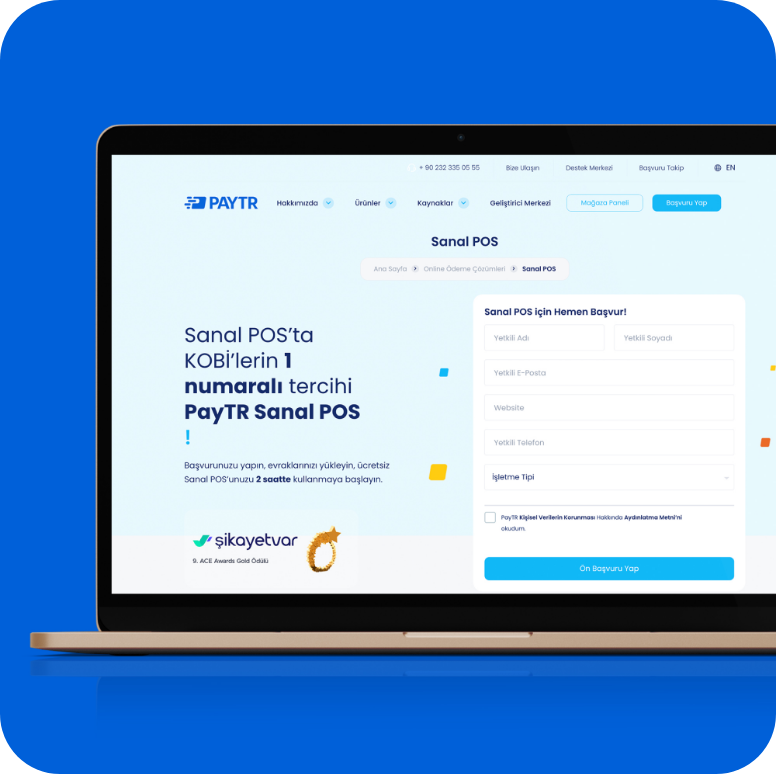
With fast installation, reliable infrastructure and favorable commission rates, PayTR Virtual POS takes your business one step ahead in the online shopping world. Start receiving payments within 2 hours with the virtual POS solution most preferred by SMEs.

Advantageous Commission Rates
Optimize your costs with our low commission rates tailored to your business needs.

Monthly and Annual Fees, No Additional Charges
Manage your payment flows with no hidden fees or annual charges, and focus on your revenue with our transparent pricing.

Receiving Secure and Fast Payments
Protect your customers’ data with the highest security standards with our PCI DSS certified infrastructure.

Single Integration, Fast Installation
Set up with a single integration and start getting paid in just 2 hours.

Receiving Payments in Different Currencies
Avoid currency conversion losses and increase your earnings when receiving payments in different currencies.

Receiving Installment Payments from All Banks
Get payments in installments from all bank cards and increase both your customer satisfaction and sales.
Increase revenue by improving the checkout experience.

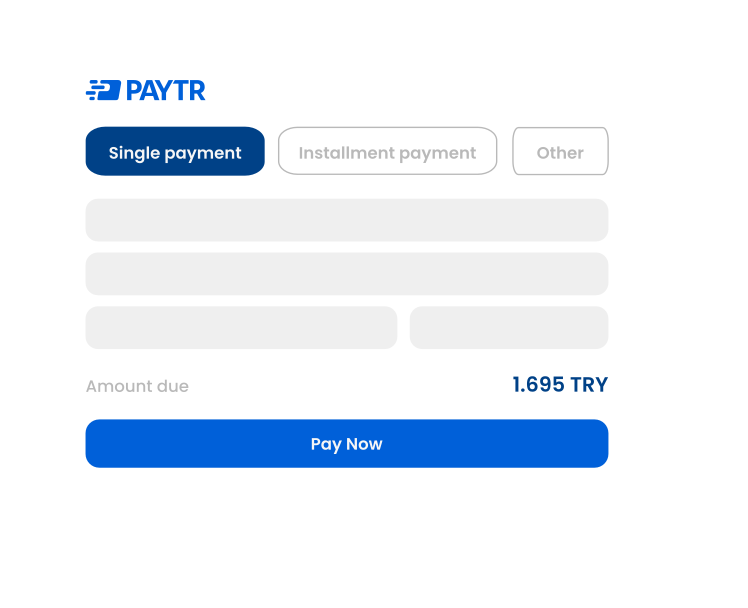
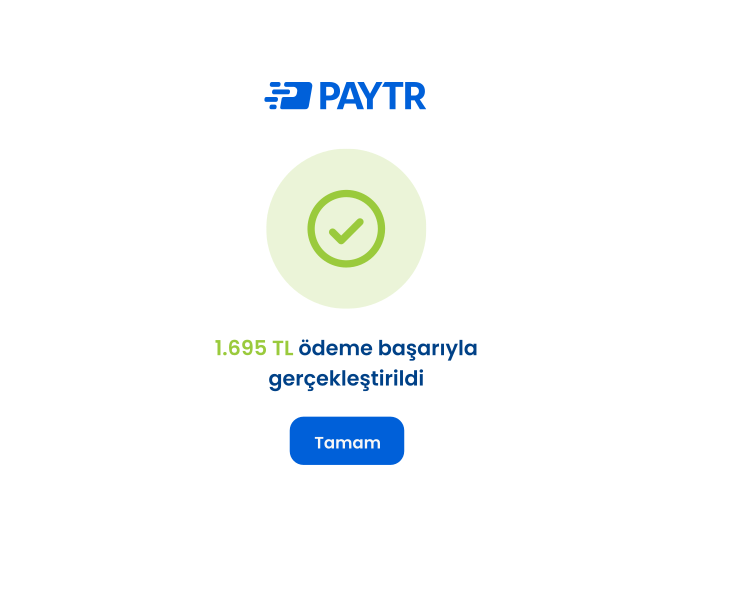
Brands that prefer PayTR Virtual POS grow their business with fast integration, secure payment infrastructure and low commission rates.






Your Virtual POS is ready to use within 2 hours after completing the online application.




Card-on-File Registry
No more need for your customers to enter their card details every time on the checkout page!

UniSupport
Every PayTR merchant can access 24/7 technical and operational support through the PayTR Merchant Panel.

Returner
During the refund process, payments that are returned due to bank or account-related problems are automatically captured and the customer who wants to receive a refund is notified.

Smart Switch
Bank POSs are monitored instantly and in the event of an outage, the system automatically redirects the payment flow to different bank POSs.

Smart Secure
PayTR's smart infrastructure monitors customer habits, and if it decides that the transaction should be Non-3D, it terminates the transaction without redirecting to the 3D Secure stage and prevents possible losses.

Smart Catch
When the payment transfer bounces back from the bank for any reason, Smart Catch automatically captures and reports this payment.

User Friendly Checkout Page
Boost conversions with a seamless, mobile-first payment page that’s fully customizable to your brand and ready out of the box.

Fraudar
Our anti-fraud infrastructure, which has a 99.8% transaction success rate, monitors all transactions instantly and always protects you against fraud risks by canceling the transaction in case of a possible fraud.
In PayTR, where advanced (PRO) and easy (Basic) APIs are used, 24/7 technical support is provided for the integration process.
Open source refers to software whose source code can be freely shared and modified. This allows solutions to be delivered across all domains, offering consumers more choices.





 +10 kaynak daha
Ready-made e-commerce infrastructures are solutions that provide you with an advanced website, enabling you to sell your products online.





 +19 kaynak daha












All the payment solutions you need at one address!

Virtual POS error codes prevent e-commerce activities from continuing uninterruptedly. It also creates a loss of reputat

With the spread of online commerce, the number of people who want to use virtual POS without owning a company is increas

Virtual POS systems are one of the most important motivations supporting the increasing e-commerce volume. Virtual POS (
Virtual POS error codes prevent e-commerce activities from continuing uninterruptedly. It also creates a loss of reputat
With the spread of online commerce, the number of people who want to use virtual POS without owning a company is increas
Virtual POS systems are one of the most important motivations supporting the increasing e-commerce volume. Virtual POS (
Fill out the application form on our page with your business details and website address. Once you approve the commission offer, upload the required documents — tax certificate, signature circular/declaration, and ID copy — digitally through the management panel. Having an SSL certificate, Distance Sales Agreement, and Refund Terms on your website speeds up the review process. After approval, complete the setup through your e-commerce platform or custom API integration and start accepting payments, usually the same day.
The application process is straightforward. Start by filling out the Virtual POS application form on the bank or payment provider's website. Your business and contact information are verified. Once approved, your Virtual POS account becomes active and you can start accepting online payments. Submitting all required documents in full speeds up the process. In some cases, additional security checks or supplementary agreements may be required — these are part of the process and essential for a secure payment infrastructure. PayTR Online POS application and setup are fast and easy.
When Virtual POS application documents are submitted in full, the process moves forward easily. The basic documents you need to have ready when applying for a Virtual POS are: ID document Company trade registry record Tax number Business details (address, industry, etc.) Signature circular IBAN information When documents are submitted complete and accurate, the application proceeds without issues and is completed easily. The approval process begins after the submitted documents are reviewed. Once approved, the POS setup is carried out. This enables you to process credit card and debit card transactions easily, both in-store and online.
Sole proprietors and capital company owners can apply easily with a tax certificate. Individuals without a tax certificate can apply with ID, proof of residence, and bank account information.
The application process is typically completed within 1 to 5 business days. Your application is reviewed during business hours and a custom offer is prepared shortly. Applications submitted outside business hours or on public holidays are reviewed on the next business day.
All legal and compliant e-commerce industries can apply for PayTR Virtual POS. The products and services sold must have the relevant legal documentation or licenses.
Your website must be ready for use and your legal agreements must be complete. Submitting the required documents for your industry ensures smooth approval.
Yes, a business activity certificate and tax number are required to apply.
The basic requirement to use Virtual POS services is to own a registered business. The following individuals and entities can apply: Sole Proprietorships: Businesses owned by a single person. Commercial Companies: All capital companies in Limited (Ltd. Şti.) or Joint Stock (A.Ş.) status. E-commerce Businesses: Those selling products or services online with an active website. Subscription/Membership Models: Digital service providers with regular collections. Tax-Exempt Individuals: In certain cases (such as homemakers or micro-entrepreneurs), applications can be submitted to payment institutions with a tax exemption certificate.
Issuing an invoice for every sale made through Virtual POS is a legal requirement under Turkish tax regulations, as banks and payment institutions report these transactions directly to the Revenue Administration. The transaction confirmation from the Virtual POS system serves only as a collection receipt, while the only financially valid document is the invoice. As of 2026, these invoices must be issued as e-Archive or e-Invoice. If invoices are not issued — regardless of the sale amount — your business is considered to have unrecorded revenue and may face severe penalties and tax inspections. Documenting every transaction is critical for both your commercial security and legal compliance.
Applying for a Virtual POS at PayTR, activating your account, or using the system requires no upfront fees, setup costs, annual dues, or fixed monthly charges. The system operates entirely on a "pay as you earn" model, so there are no costs during periods when you don't make sales. A specific commission rate — determined by your business volume and shared with you during approval — is deducted only on successful transactions. There are no inactivity fees or hidden costs.
Commission rates are determined by several factors. The main factors include the business's industry, monthly transaction volume, average transaction amount, card type (credit card or debit card), installment options, and the bank or payment institution. High-risk industries (such as digital products or subscription services) are typically subject to higher commission rates. Businesses with high transaction volumes can negotiate lower rates. Installment payments generally carry a higher commission rate than one-time payments. Businesses should compare offers from multiple providers to find the most favorable terms.
After a refund, the commission collected is returned to you. No additional fees are charged during the refund process.
Commission rates for payments in different currencies are determined based on your business model, revenue targets, and monthly transaction volume. These details are clarified during your custom offer process.
Commission rates vary because each business has a different industry, transaction volume, and payment behavior. This approach aims to deliver the most favorable cost for each business.
Installment transactions may carry additional costs set by banks. These costs are evaluated based on your business model and communicated to you.
PayTR's fraud infrastructure is a multi-layered system combining real-time data analysis, behavioral analysis, and rule-based risk controls. Transactions are evaluated in real time using parameters such as IP, device information, location, and transaction patterns. Suspicious transactions are identified through dynamic risk scoring, 3D Secure, blacklists/whitelists, and industry-specific rules, then routed to additional verification steps. The system continuously improves by learning from historical data.
The authorization rate is calculated by comparing the total number of transactions in a given period with the number successfully completed (approved). The metric includes declined transactions, fraud-blocked transactions, and technical failures. This way, true performance is measured across the entire transaction flow, not just approved transactions. The resulting rate serves as a key indicator for evaluating payment infrastructure performance, risk control effectiveness, and user experience.
The system takes automatic action on transactions flagged as risky. The transaction may be declined, routed to additional verification, or placed under review. The merchant is notified when necessary.
Fraudar runs actively on Virtual POS transactions as part of PayTR's security infrastructure. The rules and actions applied may vary based on product and risk policies.
Tokenization is used instead of storing card details for transactions with saved cards. This keeps card data securely protected.
Yes. Users can delete card details saved in the PayTR infrastructure at any time. Card data is stored securely and removed from the system upon request.
After logging into your PayTR panel, you can create a support ticket through UniSupport and track its status step by step.
Support requests are prioritized by topic and urgency. Tickets are generally answered as quickly as possible, and users are kept informed throughout the process.
Yes. UniSupport is available to all PayTR customers.
"Bank and account errors during refunds are identified through transaction result codes and bank response messages. The PayTR infrastructure monitors every refund in real time and reports the cause of failure in detail. Issues such as account information mismatches, closed accounts, bank declines, or technical errors are categorized by the system and displayed for each specific transaction. This allows businesses to quickly identify refund issues and take action."
No. Returner manages the refund process automatically. Manual review is only required in exceptional cases.
Returner identifies refunds returned due to bank declines, incorrect account information, closed accounts, or technical issues.
Routing happens automatically in milliseconds, without interrupting the payment flow.
No. SmartSwitch runs within the PayTR infrastructure and requires no additional integration.
Captured payments can be viewed as detailed reports through the PayTR panel.
Smart Cache significantly reduces the need for manual review. However, manual checks may still be required in exceptional cases.
Smart Cache identifies transactions that fail to complete due to technical outages, bank response errors, or connection issues.
3D Secure routing is triggered based on criteria such as transaction amount, user behavior, device information, and risk score.
User transaction frequency, payment patterns, device information, and location are analyzed.
Low-risk transactions are completed securely without requiring additional verification.
Smart Secure operates as part of PayTR's security infrastructure. Implementation details may vary by product and risk policy.
After transaction approval, payments are typically transferred to your account within 1 to 3 business days. PayTR offers next-day payouts, allowing you to receive funds in your bank account quickly and manage cash flow with ease.
With PayTR Virtual POS, you can accept multiple payment options including credit cards, debit cards, installment payments, and digital wallets.
Yes, you can offer installment options through Virtual POS and provide flexible payment terms to your customers.
PayTR offers next-day payouts, allowing you to receive funds in your bank account quickly and manage cash flow with ease.
You can process transactions with all domestic debit cards, including those bearing VISA, Mastercard, and TROY logos. You can also accept payments from prepaid cards.
PayTR Virtual POS supports international card payments and allows you to process transactions in multiple currencies.
Once a refund is approved, the amount is credited to your account within a short time, depending on your bank's processing times. This process is typically completed within a few business days.
Maturity and payout periods for installment payments may vary based on bank protocols. However, PayTR generally maintains next-day payouts.
Transaction security is maintained through a multi-layered structure. SSL/TLS encryption protocols encrypt all data transmitted between the customer's browser and the Virtual POS system. 3D Secure verification adds an extra identity authentication layer from the customer's bank and prevents unauthorized use. Tokenization technology replaces actual card details with secure tokens, reducing data breach risk. PCI DSS compliance ensures that card data is processed and stored securely. Regular security audits identify and fix vulnerabilities. Businesses should apply security updates promptly and stay aligned with the latest security standards.
Payments are analyzed in real time through PayTR's Frauder infrastructure. Suspicious transactions are reviewed by expert teams to prevent potential fraud.
Customer data is protected with modern encryption technologies and security protocols. Card details are transmitted through SSL/TLS-encrypted channels and protected against unauthorized access. Tokenization replaces actual card numbers with unique tokens, minimizing data breach risk. PCI DSS-compliant systems ensure card data is processed and stored securely. Most Virtual POS providers store card details on their own secure servers, so businesses don't need direct access to this sensitive data. Regular security audits and penetration tests identify and resolve vulnerabilities. Businesses have legal responsibilities for protecting customer data and must comply with regulations such as KVKK (Personal Data Protection Law).
3D Secure provides strong protection to enhance transaction security but is not mandatory. Your business can enable 3D Secure to add an extra security layer.
A token system is used to process payments from saved cards.
Yes. Saved cards can be deleted by the user at any time. Once deleted, card details are securely removed from the system.” => If using the Direct API, users cannot delete it through us — they must delete it from the service provider. For users to delete it via us, the iFrame API must be in use.
No, Virtual POS and transaction information is protected under PCI DSS standards and is not shared with third parties.
No. Payment transactions are processed over secure connections, and your information is protected if the connection drops.
Yes. All transactions can be viewed retrospectively through the PayTR panel.
Yes. Country-based risk analysis and additional controls may be applied.
SMS verification is applied based on the bank and transaction type. It is not mandatory for all transactions.
Yes. Banks protect transactions with 3D Secure and similar additional security layers.
Yes. Using up-to-date browsers and operating systems contributes to stronger security.
Contact the PayTR support team for the relevant transaction to request a review. The process is evaluated based on the bank and transaction status.
Yes. Using up-to-date browsers and operating systems contributes to stronger security.
PayTR Virtual POS Smart Secure is an advanced Virtual POS solution that addresses this need by combining 3D Secure technology with a smart verification layer to protect both merchants and buyers. For details, see (blog link)
Virtual POS works entirely online, while in-store POS is used for face-to-face sales at stores or service points. Virtual POS enables global sales with no geographic limits, while in-store POS can only be used where the device is located. In-store POS involves hardware costs and maintenance expenses, while Virtual POS is software-based with no such costs. Both systems use encrypted data transmission for security, but additional verification layers like 3D Secure are more common with Virtual POS. With in-store POS, the customer's card is physically swiped to process the transaction, while card details are entered manually with Virtual POS. Both systems have their own advantages, and businesses should choose based on their needs.
Applying with a tax certificate as a sole proprietorship or capital company is recommended. For individual applications without a tax certificate, ID, residence, and bank information may be required.
You can find comprehensive API documentation and code samples at Dev.paytr.com. These resources contain everything you need during integration.
PayTR accepts all SSL certificates, and you can get support from your hosting provider to install it on your site. This way, your visitors can transact over a secure connection.
It integrates with many ready-made e-commerce platforms such as WooCommerce, OpenCart, Magento, and Shopify. A Pro API solution is also available for custom software.
Yes, PayTR's expert technical team supports you throughout the integration process. You can get help whenever needed for a fast and smooth setup.
Technical issues are resolved by contacting the Virtual POS provider's technical support team. Most providers offer 24/7 technical support and work to resolve issues quickly. Common issues include integration errors, transaction declines, connection problems, and security certificate issues. When experiencing issues, businesses should first record error messages and transaction details, then share them with the support team. Some issues may relate to the website's security certificate or server configuration, requiring contact with the hosting provider. Regular system updates and maintenance help prevent technical issues. Keeping a backup Virtual POS system also ensures uninterrupted service if one system fails.
Yes. UniSupport is available to all PayTR customers.
PayTR, 2009’dan bu yana geliştirdiği başta Sanal POS olmak üzere, tüm yeni nesil ödeme teknolojileriyle işletmelerin güvenli, hızlı ve kolay ödeme almasını sağlar. Bugün 200 binden fazla işletmeye online ve fiziki ödeme çözümleri sunar.
PayTR Ödeme ve Elektronik Para Kuruluşu A.Ş. bir TÖDEB üyesidir.

PayTR Payment and Electronic Money Institution Inc. is a licensed electronic money and payment services institution established under Law No. 6493, regulated by the Central Bank of Turkey (TCMB). The PayTR brand is a registered trademark of PayTR Payment and Electronic Money Institution Inc.


We use cookies to provide you with a better shopping experience. For more information, you can review our cookie policy and the statement regarding personal data protection.